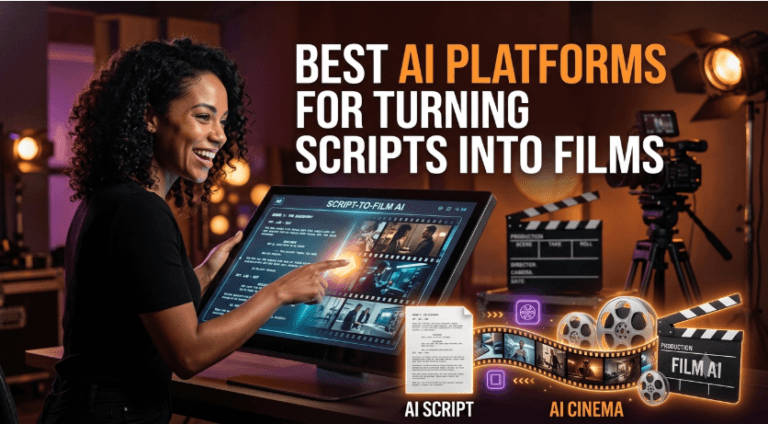


Cinematic storytelling depends on more than generating attractive footage. A strong visual story needs characters with purpose, scenes that connect, controlled pacing, and a visual language that supports the narrative.
AI filmmaking platforms are making it easier to experiment with these elements before committing to a full production. Some are designed for individual shots, while others help with story development, visual planning, character creation, or complete creative workflows.
If you’re looking beyond Higgsfield, these platforms offer different approaches to building cinematic stories with AI.
Six Platforms for Developing Cinematic Stories
The following tools take different routes from an initial idea to visual storytelling, giving filmmakers more options depending on how they approach production.
1. Invideo agent
Invideo agent approaches cinematic storytelling as a complete creative project rather than a collection of disconnected generations. A filmmaker can start with a story idea and continue developing it through scripts, scenes, references, footage, and edits.
The platform brings together 200+ AI models, giving creators flexibility when developing different parts of a project. It can work with scripts, PDFs, brand books, videos, rough cuts, and uploaded footage, allowing existing creative material to become part of the production process. It also offers an AI lip sync video feature, helping creators synchronize dialogue with characters for more natural-looking scenes.
With invideo agent two, filmmakers can also create agent roles such as a DOP, storyboard artist, casting director, or creative producer. The agent can retain project context, including characters, lighting choices, references, and earlier creative decisions, so the story can develop without repeatedly rebuilding the same foundation.
Pricing: Invideo offers Plus at $17/month, Max at $85/month, and Generative at $170/month.
Creative approach: Best suited to projects where story development, references, production roles, and multiple creative decisions need to stay connected.
2. Vidu
Vidu focuses on text-to-video and image-to-video creation, giving filmmakers a straightforward way to turn visual ideas into moving scenes.
For cinematic projects, creators can start with concept art, character references, or storyboard frames and use them as the foundation for developing shots. This makes it useful when the visual direction has already been established and the next step is exploring motion.
Vidu can work well for atmospheric sequences, establishing shots, transitions, and other short scenes that need to contribute to a larger narrative.
Pricing: Vidu offers Standard at $10/month, Premium at $35/month, and Ultimate at $99/month.
Creative approach: A practical choice for turning existing visual references into motion and experimenting with individual cinematic shots.
3. Hailuo AI
Hailuo AI is built around generative video and can help filmmakers experiment with cinematic scenes from text or image references.
A creator can describe a scene, establish a visual starting point, and generate different interpretations of the same moment. This can be useful when exploring camera movement, atmosphere, character actions, or environmental details.
Rather than committing to one visual treatment immediately, filmmakers can use these variations to discover which interpretation works best for the story.
Pricing: Hailuo AI offers Standard at $10.50/month, Master at $89/month, and Max at $216/month.
Creative approach: Useful for testing several interpretations of a scene before settling on a visual direction.
4. PixVerse
PixVerse provides text-to-video and image-to-video capabilities that can be used to develop short cinematic sequences.
Its image-based workflow is useful for filmmakers who already have concept frames or visual references and want to see how those ideas might translate into motion. Multiple variations can also be explored before choosing a direction for a particular scene.
For narrative projects, this can be useful for visual experiments, transitions, action moments, and supporting footage.
Pricing: PixVerse offers Standard at $10/month, Pro at $30/month, and Premium at $60/month.
Creative approach: Works well for filmmakers who want to quickly explore different versions of a visual idea and turn still references into moving sequences.
5. Artlist AI
Artlist AI takes a broader creative approach by combining AI generation with resources that can support the wider production process.
For cinematic storytelling, this can be useful when a project needs more than generated visuals. Music, sound, and other creative assets can contribute significantly to the mood and pacing of a scene.
Creators can therefore use the platform as part of a wider workflow, developing visual ideas while also considering the audio and supporting elements that help turn those visuals into a finished story.
Pricing: Artlist offers AI Starter at $19/month, AI Creator at $69/month, and AI Professional at $399/month.
Creative approach: Particularly useful for creators who want to develop cinematic visuals alongside music and other supporting production assets.
Start With the Narrative, Then Develop the Visuals
One of the biggest mistakes in AI filmmaking is starting with visual generation before deciding what the story needs.
A cinematic project becomes easier to manage when the narrative is broken into scenes and important moments first. Characters, locations, tone, and visual references can then be established around that structure.
This also makes it easier to identify which scenes need detailed AI generation and which can be handled through live footage, stock material, animation, or traditional production.
Cinematic Consistency Still Matters
A collection of impressive AI shots does not automatically become a coherent film.
Characters may change between generations, locations can lose their visual identity, and lighting can shift from one scene to another. These inconsistencies become more noticeable when clips are placed next to each other.
For that reason, filmmakers should treat references and creative direction as part of the production process. Establishing visual rules early can help individual generations feel like parts of the same story.
Choosing the Right Workflow
Different cinematic projects need different levels of AI involvement.
A filmmaker developing a visual concept may want a fast generation tool. A short-film creator may need stronger scene development and reference workflows. A creative agency might need a broader system that can handle scripts, footage, and multiple production roles.
The goal is not necessarily to find the platform with the most features. It is to find one that fits the way your story moves from concept to finished piece.
Final Thoughts
Higgsfield is one option for cinematic AI creation, but it is far from the only approach. Vidu, Hailuo AI, PixVerse, and Artlist AI each provide different ways to explore visuals and develop narrative projects.
Invideo agent takes a broader project-based approach, combining 200+ AI models, persistent creative context, specialist agents, and support for scripts, references, footage, scene development, and editing.
For cinematic storytelling, AI works best when it supports the creative direction rather than becoming the direction itself. Start with the story, define the visual language, and then use the right platform to bring individual scenes to life.