
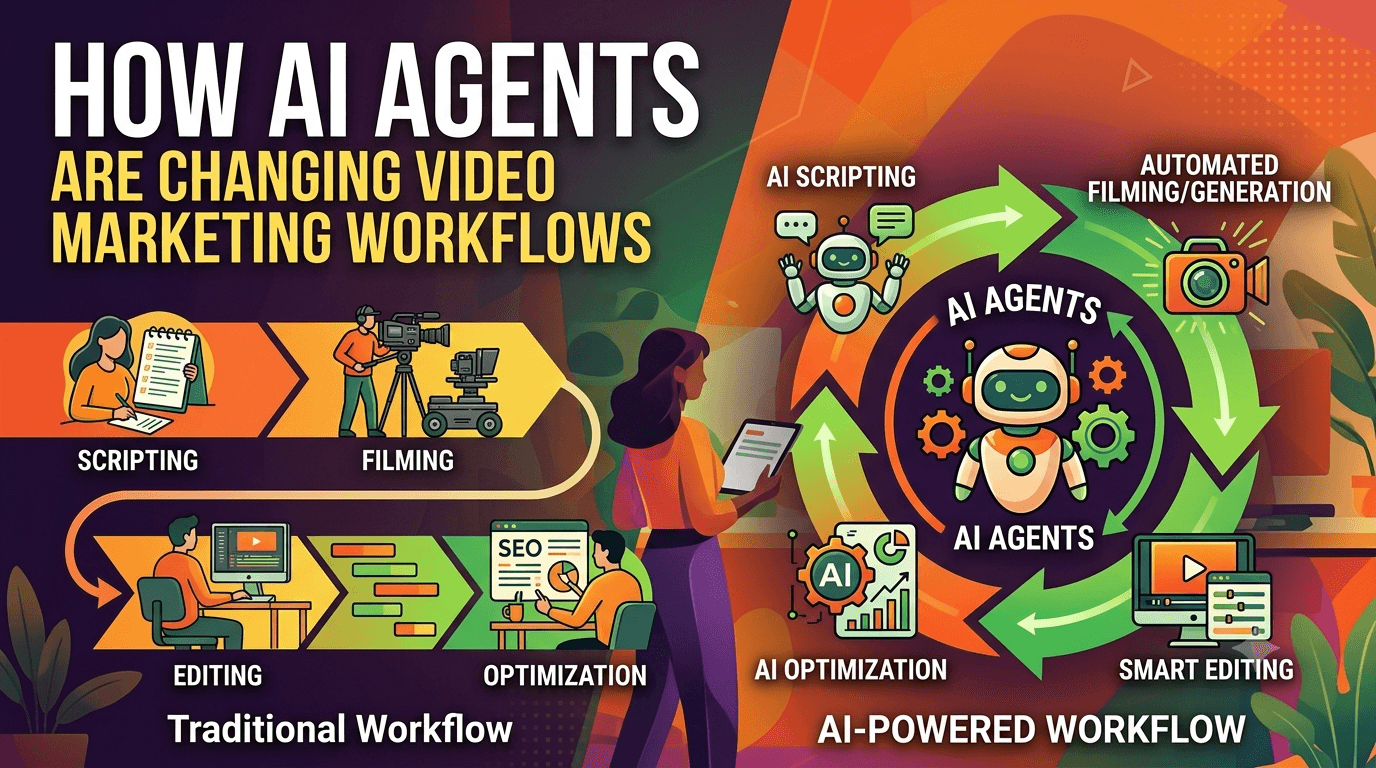

Video marketing has become a production problem as much as a creative one. A single campaign can require scripts, product visuals, short-form clips, voiceovers, edits, different aspect ratios, and multiple versions for different audiences.
Traditional AI tools can speed up individual tasks, but marketers still have to move information from one tool to another and make decisions at every stage. AI agents are changing that model by connecting those tasks into a more continuous workflow.
Instead of simply generating what they are asked to generate, AI agents can work with context, respond to instructions, handle multiple steps, and help move a project from an idea toward a finished asset.
From AI Features to AI Workflows
The difference between an AI feature and an AI agent is easiest to understand through a simple example.
An AI video generator can create a video from a prompt. An AI agent can take a campaign brief, understand the objective, help develop the script, create the required assets, make changes based on feedback, and continue working on the same project.
That shift matters for marketing teams because video production rarely consists of one isolated task.
One Brief Can Drive Multiple Outputs
A product launch might require:
- A 60-second campaign video
- Several short social clips
- Product-focused ads
- Vertical versions
- Different hooks
- Voiceover variations
- Videos for different audiences
An agent-based workflow can make it easier to treat these as connected outputs rather than completely separate projects.
Invideo Agent Brings the Workflow Together
Invideo agent is designed around this broader approach to video creation.
Instead of starting from a blank editing timeline, marketers can provide a campaign idea, script, reference material, existing footage, PDFs, or other project information. The agent can then help develop the video while working with the context provided.
The platform also gives users access to 200+ AI models, allowing different creative requirements to be handled within the same workflow. With invideo agent two, the system can retain project information as work continues, including details about characters, visual direction, lighting, and other creative decisions.
Marketers can also create specialist AI agents for different roles, such as a scriptwriter, creative director, or other project-specific responsibilities. This can make it easier to develop AI-generated UGC ads with different scripts, concepts, and creative directions for specific audiences or campaigns.
This can be useful for teams producing multiple campaigns because the workflow is not limited to generating one video from one prompt. The same project context can support further iterations and content variations.
The Brief Becomes the Starting Point
One of the biggest changes AI agents bring to video marketing is how production begins.
Previously, marketers often had to translate a campaign brief into separate instructions for different tools.
The script went into one platform. Visual assets were created somewhere else. Voiceovers were handled separately. Editing happened in another application.
AI agents can reduce some of that fragmentation by allowing the original brief to remain part of the workflow.
Context Reduces Repetition
Consider a campaign for a new skincare product.
The team may define:
- Target audience
- Brand tone
- Product benefits
- Key messaging
- Visual direction
- Campaign objective
If those details remain available throughout the project, marketers do not need to repeatedly explain the same requirements at every stage.
Faster Iteration Changes the Creative Process
Marketing teams rarely get everything right on the first attempt.
A hook might not work. A product shot may need changing. A video may feel too long. The same concept may need to be adapted for another platform.
AI agents can make these iterations more conversational.
Feedback Can Become an Instruction
Instead of manually rebuilding a project, a marketer can provide feedback such as:
Make the opening more direct and shorten the product section.
Or:
Keep the same concept but make the version suitable for a younger audience.
The goal is not to eliminate human review. It is to make the path between feedback and a new version shorter.
More Variations Without More Production Layers
Personalisation has become an important part of digital advertising.
A campaign may need different creative versions based on audience, platform, product, location, or message.
Creating every version manually can quickly become expensive.
One Concept, Multiple Executions
An AI agent can help marketers explore variations around a central idea.
For example, one product campaign could have different openings for:
- New customers
- Returning customers
- Price-conscious shoppers
- Product enthusiasts
The core message remains connected while the presentation changes.
AI Agents Can Help With Creative Exploration
Agents are not only useful after the creative direction has been decided.
They can also support the earlier stages of ideation.
A marketer could begin with a product, audience, and campaign goal and explore different concepts before committing resources to production.
Test Ideas Before Production
Instead of debating five concepts for several days, teams can use AI to develop rough versions of each.
That gives creative teams something tangible to compare.
The winning concept can then receive more attention during production.
Repurposing Becomes Part of the Workflow
One of the biggest opportunities for AI agents is turning existing content into additional assets.
A long-form product video can become short clips. A webinar can become social content. A campaign video can be adapted into different formats.
Think in Content Systems
Rather than asking, “What video should we make?” marketers can ask:
“What content can this campaign produce?”
That change in thinking can help teams get more value from each creative project.
Human Approval Still Matters
Automation does not remove the need for creative judgment.
Marketing teams still need to decide whether a message is accurate, whether the tone fits the brand, and whether the final video actually communicates the intended idea.
Let AI Handle Production Friction
AI agents are most useful when they reduce repetitive work without taking away meaningful creative decisions.
The marketer can remain responsible for the brief, positioning, messaging, and final approval while the agent handles more of the production process.
What This Means for Smaller Marketing Teams
Large brands can divide video production among strategists, writers, designers, editors, and producers.
Smaller teams often cannot.
An agent-based workflow can give a small marketing team access to capabilities that would otherwise require several separate production steps.
More Output From the Same Team
The goal is not necessarily to publish more content for the sake of volume.
It is to make it possible to test more concepts, produce more useful variations, and keep campaigns moving without adding another layer of manual work.
The Next Video Workflow Is More Connected
AI video generation is moving from individual tools toward systems that understand what marketers are trying to accomplish across a project.
The important shift is not simply that AI can create videos. It is that agents can connect briefing, ideation, scripting, production, iteration, and repurposing into a more continuous workflow.
For marketers, that could mean less time moving assets between tools and more time deciding what the content should actually say.
As AI agents become more capable, the advantage may belong less to teams that generate the most videos and more to teams that build the smartest workflows around them.