

Type your full name into ChatGPT. Then try Gemini, Perplexity, and Google’s AI Mode. If you’ve never done it, the results can be unsettling. You might find an old lawsuit described as a conviction, a job you left in 2019 listed as your current role, or your biography blended with someone who shares your name and has a much worse one.
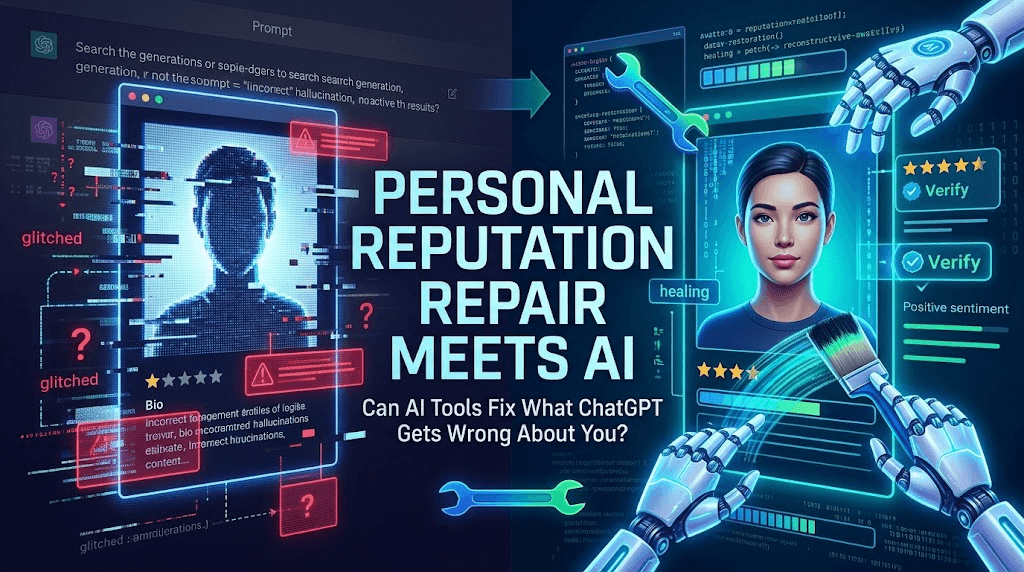
So, can AI tools fix what ChatGPT gets wrong about you? Not directly. No software can log into ChatGPT and edit what it believes about you. AI tools can show you exactly what’s being said, where it comes from, and whether your corrections are working. Personal reputation repair in the AI era means fixing the sources AI models read, then using AI tools to measure whether the answers change.
That distinction matters, because plenty of people are about to spend money on the wrong half of it.
Why does ChatGPT get facts about people wrong?
Large language models don’t look you up the way a background-check database does. They predict plausible text from patterns in their training data, and when they have web access, they pull from whatever pages rank or get retrieved for your name. Both routes break in predictable ways.
When the model is answering from training data alone, it’s working from a snapshot that may be a year or more old. If the only substantial coverage of you is a 2021 news story about a business dispute, that story is your biography as far as the model knows. Nothing you’ve done since exists.
When the model searches the web, it inherits the quality of the search results. Thin profiles, scraped people-search listings, and a single negative article can carry more weight than they deserve simply because there’s nothing better to cite.
And sometimes the model invents things outright. In March 2025, the privacy group noyb filed a complaint in Norway on behalf of Arve Hjalmar Holmen after ChatGPT told a user he had murdered two of his children and been sentenced to 21 years. None of it was true. The output mixed real details, like his hometown and the number of kids he had, with a fabricated crime. That blend of accurate and false is what makes AI errors so damaging. The real details make the fake ones believable.
This isn’t a fringe problem. A study led by the European Broadcasting Union and the BBC, published in October 2025, reviewed more than 3,000 responses from ChatGPT, Copilot, Gemini, and Perplexity and found that 45% contained at least one significant issue. Sourcing problems showed up in 31% of answers. That research tested news questions, not questions about individuals, but the failure modes carry over: wrong attribution, outdated facts, and confident claims with nothing behind them.
The audience asking AI about you is now enormous
Five years ago, a recruiter, a prospective client, or a first date would Google you and skim ten blue links. They’d see the bad article, but they’d also see your LinkedIn, your company bio, maybe a podcast interview. They could weigh it.
AI collapses those ten links into one paragraph. Nobody has to scroll past the negative result to find the context; the model has already decided what the context is.
Pew Research Center found in a February 2026 survey that 49% of U.S. adults use AI chatbots like ChatGPT, Gemini, or Copilot, up from 33% in 2024. Among adults under 50, ChatGPT use is a majority behavior. Those are the people hiring you, investing with you, renting to you, and deciding whether to take your sales call.
Some of them will never see a search results page at all.
What AI tools can actually do for personal reputation repair
Here’s where the honest answer gets more useful. AI tools are bad at fixing reputations and good at diagnosing them. Use them for the second job.
- Audit what each model says: Run the same set of prompts across ChatGPT, Gemini, Claude, Perplexity, and Google AI Overviews. Use your name alone, your name plus your company, your name plus your city, and your name plus words like “lawsuit,” “fraud,” or “review.” Save every response with a date. This becomes your baseline.
- Trace the citations: Perplexity and AI Overviews show their sources. ChatGPT often does when browsing is on. Those links tell you which pages are shaping your AI profile, and they’re rarely the ones you’d guess. A forgotten forum thread or a people-search site can outrank your own website as a source.
- Spot entity confusion: If the model attributes someone else’s career, arrest, or bankruptcy to you, that’s a disambiguation problem, not a reputation problem in the usual sense. You fix it differently, mostly by making your own identity unmistakable online.
- Track change over time: Rerun your prompt set monthly. AI answers drift as models update and new content gets indexed. Without a baseline, you can’t tell whether your work is paying off or whether a model just happened to phrase things more kindly this week.
- Draft corrective content faster: AI writing tools can help you produce a first draft of a bio, a Q&A page, or a LinkedIn article. Treat the output as raw material. Generic, AI-sounding copy is exactly the kind of content search engines discount, and it won’t move the needle.
Notice what’s missing from that list: anything that changes the model itself. That’s the part people keep hoping for, and it doesn’t exist.
What AI tools can’t do (and what to be skeptical of)
You’ll see vendors promising to “remove negative content from ChatGPT” or “reprogram AI to say positive things about you.” Be careful.
There’s no dashboard where a third party edits ChatGPT’s knowledge of a private individual. OpenAI does offer a privacy request process where people can ask for personal data to be removed from model outputs, and in some jurisdictions, GDPR gives you a right to correction. But OpenAI weighs those requests against public interest, and a successful request doesn’t guarantee the false claim disappears from every answer. In an earlier 2024 noyb complaint, OpenAI reportedly told a public figure it couldn’t correct a wrong birth date ChatGPT kept giving, only block it, and that blocking would filter other information about him too.
Legal routes are slow and uncertain, too. In May 2025, a Georgia court ruled for OpenAI in Walters v. OpenAI, the first U.S. defamation case over a ChatGPT hallucination. Radio host Mark Walters had been falsely described as embezzling from a gun-rights group. The court found no defamatory meaning partly because users are warned that outputs can be wrong, and because Walters showed no actual damages. Activist Robby Starbuck has since sued Google in Delaware over AI-generated accusations of sexual assault and a criminal record. These cases are worth watching, but nobody should treat litigation as a reliable fix. You’re looking at years, legal fees, and an unclear result.
Then there’s prompt manipulation: stuffing hidden instructions into web pages so AI tools repeat flattering claims. It’s a bad idea. AI providers are actively building defenses against it, and if it’s discovered, the story becomes “person tried to trick AI about their past,” which is worse than whatever you started with.
How to actually change what AI says about you
If AI models repeat what the web says, the fix is to change what the web says. That’s old-fashioned reputation work with a new scoreboard.
Correct the record at the source
Start with the citations you found in your audit. Outdated bios on former employers’ sites, conference pages with your old title, directory listings with wrong details: contact the owners and ask for updates. Many will fix it in a day. For people-search and data-broker sites, file opt-out requests. They’re tedious, but these sites get scraped and cited constantly.
If a news article contains a factual error, ask the publication for a correction. If a case was dismissed or charges dropped, ask for an update noting the outcome. A dismissed lawsuit that still reads like an active one is one of the most common sources of AI distortion out there.
Build pages that answer the questions people ask AI
AI tools favor content that directly answers a question. A personal website with a clear “About” page, written in plain, factual sentences, gives models something solid to quote. Include your full name, current role, location, notable work, and, if relevant, a short and calm explanation of any past issue.
That last part makes people nervous. But silence doesn’t make a negative story go away in an AI answer. It just means the negative source is the only one with anything to say. A factual sentence like “The 2022 lawsuit was dismissed with prejudice in 2023” gives the model a better source to work from.
Earn coverage on sites AI trusts
Your own website helps, but AI systems lean heavily on third-party sources. A profile in a trade publication, a guest article on a respected industry blog, a podcast transcript, or a speaker bio on a recognized event site will usually carry more weight than anything you publish about yourself. This is the slowest part of the work and the most valuable.
Make your identity unambiguous
If you share a name with someone notorious, consistency is your friend. Use the same name format, headshot, title, and city across LinkedIn, your website, and every bio you control. Mention your company and location together. Models can’t tell people apart if the signals blur.
Monitor, measure, repeat
Go back to your prompt set every month. Look for three things: whether the negative claim still appears, whether it’s framed with more context, and which sources are now being cited. You’re looking for a trend, not a one-time fix.
How long does AI reputation repair take?
Longer than you want, shorter than you fear. Models with live web access, like Perplexity and Google AI Overviews, can reflect source changes within weeks once new pages are indexed. Answers driven by a model’s training data move slower because they depend on the next model update, which can take months.
A realistic window for noticeable change is three to six months for most individuals, assuming you’re correcting sources and publishing new material consistently. Severe cases, like widely syndicated news coverage or a viral incident, can take a year or more.
When to bring in professionals
If the problem is a stale bio and a wrong job title, you can probably handle it yourself with the steps above. If the problem is a false criminal allegation, a widely covered controversy, or an AI answer that’s actively costing you clients or job offers, get help.
A firm that does personal reputation repair work today has to handle both traditional search and AI answers, because they now feed each other. Personal reputation repair at firms like NetReputation typically combines source cleanup, content development, earned media, and ongoing monitoring of how AI tools describe a client. For people whose AI visibility problem is part of a broader brand or business issue, generative engine optimization services focus on shaping how ChatGPT, Gemini, and Perplexity represent a name in the first place.
Whoever you hire, ask them to show you their AI audit process before you sign anything. If they can’t explain which sources are driving your current AI answers, they’re guessing.
The real answer
AI tools can’t fix what ChatGPT gets wrong about you. They can tell you exactly what’s wrong, where it came from, and whether your fixes are landing. The repair itself is the same patient work it’s always been: correct bad sources, publish better ones, and earn credible coverage. What changed is that the audience reading your reputation is now a machine that summarizes, and it only knows what the web tells it.
Give it better material.
Frequently Asked Questions
Can I make ChatGPT delete false information about me?
You can submit a privacy request to OpenAI asking it to remove or stop processing your personal data, and EU residents may have GDPR correction rights. OpenAI evaluates each request against public interest, and approval doesn’t guarantee the false claim disappears everywhere. Correcting the web sources the model draws from is the more dependable path.
What is personal reputation repair?
Personal reputation repair is the process of correcting, contextualizing, or outweighing damaging information about an individual online. Today it covers both traditional search results and AI-generated answers from tools like ChatGPT, Gemini, and Perplexity, since these systems pull from the same web sources and shape first impressions of a person.
Why does ChatGPT confuse me with someone else?
ChatGPT confuses people with shared names when the online signals about each person overlap or are thin. If your profiles use inconsistent name formats, titles, or locations, the model has trouble separating you. Keeping your name, headshot, role, and city consistent across every profile you control helps AI systems treat you as a distinct person.
Can I sue an AI company for defamation?
You can file a lawsuit, but early U.S. results haven’t favored plaintiffs. In Walters v. OpenAI (2025), a Georgia court ruled for OpenAI, citing output disclaimers and a lack of proven damages. Other cases are pending. Litigation is slow and costly, so most people pair legal advice with source-level reputation work.
How do I check what AI says about me?
Run the same prompts across ChatGPT, Gemini, Claude, Perplexity, and Google AI Overviews: your name alone, plus your company, plus your city, and plus terms like “lawsuit” or “reviews.” Save each answer with the date and note any cited sources. Repeat monthly to see whether your corrections are changing the results.
How long does it take to change AI answers about a person?
Tools with live web access, such as Perplexity and Google AI Overviews, can reflect corrected sources within weeks of indexing. Answers based on a model’s training data change more slowly, often waiting on the next model update. Most individuals see noticeable improvement in three to six months of consistent source correction and content work.