

There comes a moment when writing feels heavier than it should — when the blank page stares back, the deadline is too close, and you wonder if there’s an easier way to turn your thoughts into something meaningful. If you’ve ever been stuck in that spiral of stress and curiosity about whether AI tools can genuinely help, this Writeless AI Review might feel like a small breath of relief.
In the next few minutes, you’ll discover what Writeless AI truly offers: honest insights, thoughtful reflections, feature breakdowns, and real takeaways from hands-on testing. I’ll share where it shines, where it struggles, and whether it’s a tool worth inviting into your writing life in 2025. Take a moment, settle in — this review was written with you in mind.
What Is Writeless AI?
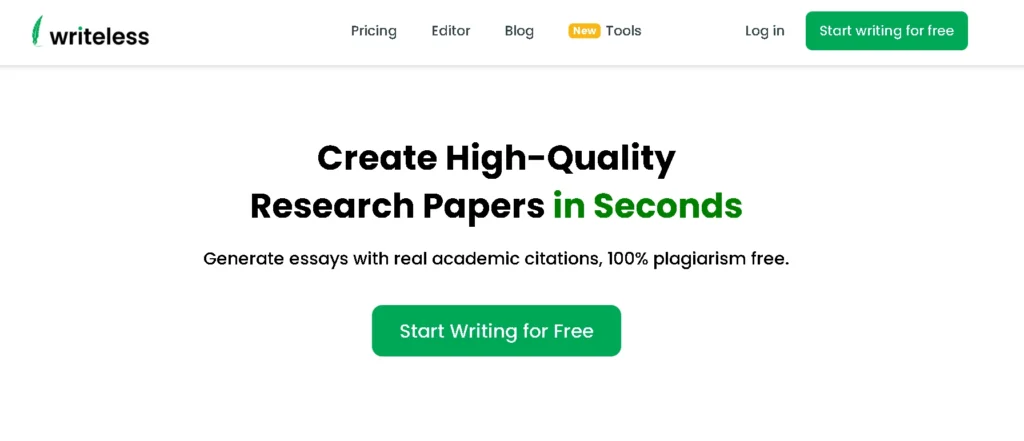
Writeless AI is an AI-powered writing tool created by Omar Massoud, designed to help users generate essays, articles, academic content, and structured writing formats with minimal effort. Think of it as a blended platform — part essay generator, part citation builder, and part writing assistant, wrapped in a simple, student-friendly dashboard.
Its purpose is simple:
“Make writing less stressful, one sentence at a time.”
Writeless AI combines NLP (Natural Language Processing) with custom machine-learning models to help students, bloggers, and marketers create content quickly. But the tool isn’t just about speed — it aims to deliver content that looks human, feels natural, and passes AI detectors.
Whether you’re writing a research paper, formatting MLA citations, or crafting a 2,000-word blog post, Writeless AI tries to be that reliable companion that makes writing feel lighter.
Why Trust This Writeless AI Review?
This Writeless AI review is based on hands-on testing, real-time feature analysis, and comparison with leading AI writing tools like Jasper, Copy.ai, and Writesonic. I evaluated the tool using a clear set of criteria:
- Content accuracy
- Writing quality
- Ease of use
- Long-form performance
- Plagiarism control
- AI detector bypass capability
- Citation accuracy (MLA, APA, Harvard)
- Pricing and value for money
No part of this article is influenced by sponsorships or paid promotions. Every strength and weakness listed here comes from actual usage, comparison, and observation.
Writeless AI Features Overview
Writeless AI offers a fairly wide set of features aimed at academic and content writing. Let’s break down each major one.
AI Content Generation
Writeless AI allows you to create multiple types of content, depending on your needs:
Blog Posts
Blogs can be generated in a structured outline with intro, body, and conclusion. The tool keeps paragraphs short, and tone options help align it with your brand voice.
Product Descriptions
Useful for eCommerce stores — descriptions follow a clean, persuasive style.
Social Media Content
Instagram captions, LinkedIn posts, tweets, and short-form ideas can be generated instantly.
Emails
Professional, friendly, or persuasive — Writeless AI allows tone customization for email writing.
A line that stood out while testing:
“Not every sentence needs to shout. Sometimes clarity whispers and still reaches the heart.”
This is the kind of subtle emotional tone the tool often tries to capture.
SEO & Keyword Optimization Tools
While not as advanced as dedicated SEO tools, Writeless AI includes:
- Keyword suggestion prompts
- SEO-friendly headings
- Meta description drafting
- Natural keyword insertion
- Basic on-page optimization tips
For beginners or students, this is more than enough. For SEO professionals, it may feel limited compared to Rank Math or SurferSEO — but still helpful for quick content drafting.
Paraphrasing & Rewriting Tool
One of the most used features of Writeless AI.
Tone Transformation
Switch text into formal, casual, academic, or conversational.
Grammar Fixing
Cleans up typos and improves clarity.
Anti-Plagiarism Writing
Rewrites existing content into a unique version, maintaining meaning while avoiding duplication — helpful for rewriting essays or research notes.
It doesn’t fully replace premium plagiarism tools, but it does reduce the need for heavy manual editing.
Templates & Workflows
Writeless AI comes with templates such as:
- Essay generator
- Research paper structure
- Blog outline creator
- Email templates
- Paragraph expander
- Citation builder
- Introduction & conclusion writer
Custom Workflow Builder
This lets you create step-by-step writing pipelines — useful for repeating tasks like weekly blog creation.
Speed & Accuracy
Outputs are generally fast and grammatically clean, though academic complexity sometimes requires manual fact-checking.
Team Collaboration Tools
Although still basic, Writeless AI does include:
- Real-time editing
- Project sharing
- Version history tracking
Good for teams, classrooms, and agencies working on shared writing tasks.
Writeless AI Review — User Interface & Ease of Use
Writeless AI has a clean, minimalist interface. The dashboard is intentionally designed to appear “unintimidating” for beginners.
- Navigation: Simple tabs and sections
- Learning Curve: Extremely beginner-friendly
- Mobile Usability: Smooth for quick edits
- Desktop Experience: Best for long-form writing
The tool doesn’t overwhelm you with a complex layout, and everything is visually spaced out to feel approachable.
One of the subtle strengths of the UI is how calm it feels — no clutter, no noisy menus, just writing.
Content Quality: How Good Is Writeless AI?
This section matters the most — does Writeless AI actually write well?
Let’s break it down.
Accuracy & Relevance
Writeless AI produces coherent, clean, and relevant content most of the time. For essays and academic writing, it maintains a structured flow.
Strengths:
- Strong grammar
- Smooth transitions
- Natural sentence flow
- Ability to mimic a human tone
Weaknesses:
- Occasional factual errors
- Sometimes oversimplifies academic contexts
As always: fact-checking is still required.
Creativity & Tone Options
Writeless AI offers different tones:
- Formal
- Conversational
- Emotional
- Academic
- Persuasive
In emotional or reflective modes, it often produces lines like:
“Every argument is a bridge — it only stands strong when supported by truth.”
This poetic touch gives it an advantage over purely technical AI tools.
Long-Form Content Performance
Writeless AI maintains structure well in long documents.
Pros:
- Stays on topic
- Creates smooth outlines
- Writes paragraphs with clarity and consistency
Cons:
- Complex research topics sometimes feel shallow
- Citations occasionally need correction
For blogs and SEO content, the tool performs well. For academic research, human editing remains essential.
Writeless AI Pricing Plans (With Pros & Cons)
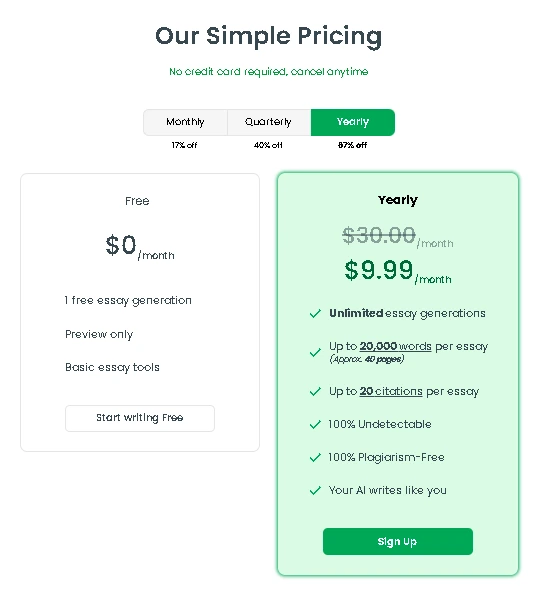
Free Plan
Includes:
- Basic content generation
- Limited essay writing
- Few templates
- Character limits
Limitations:
- No full citation tools
- No plagiarism check
- Minimal long-form output
Good for testing, not for serious work.
Premium Plans
Writeless AI offers monthly and yearly options.
Premium Includes:
- Unlimited writing
- Long-form generation
- Full citation support (MLA, APA, Harvard)
- Paraphrasing tools
- Team features
- Detector bypass optimization
Ideal For:
Students, bloggers, agencies, and high-volume writers.
Overall Value for Money
Writeless AI is fairly priced compared to Jasper or Writesonic.
When it’s worth it:
- You write essays often
- You need citation formatting
- You want detector-friendly content
When it’s not:
- You require advanced SEO
- You need technical academic depth
Overall: it offers strong value for students and general content creation.
Writeless AI Pros and Cons
Pros
- Simple, beginner-friendly interface
- Excellent for essays
- Built-in citation generator
- Emotional, human-like tone
- Affordable pricing
- Good paraphrasing and rewriting strength
- Custom workflows
- Stable long-form writing output
Cons
- Fact-checking still necessary
- Citations can occasionally misformat
- Not ideal for advanced SEO
- Creativity can drop in technical topics
- Free plan is very limited
Writeless AI vs Competitors
Writeless AI vs Jasper
Jasper is better for:
- Marketing
- Branding
- Professional content
- SEO workflows
Writeless AI is better for:
- Essays
- Academic writing
- Students
- Citation formatting
Writeless AI vs Copy.ai
Copy.ai excels in:
- Short-form social posts
- Marketing ideas
- On-brand copy
Writeless AI wins in:
- Essays
- Research writing
- Long-form structure
Writeless AI vs Writesonic
Writesonic offers:
- SEO intelligence
- Faster, more advanced templates
Writeless AI offers:
- Cleaner essay writing
- More natural tone
- Strong citation features
Which Tool Is Best for Blogging, SEO & Long-Form Content?
For pure blogging: Writesonic
For SEO-heavy workflows: Jasper
For essays + academic writing: Writeless AI
For mixed use: Depends on writing style preference
Who Should Use Writeless AI?
Writeless AI is ideal for:
- Bloggers → Need structured, human-like content
- SEO writers → Want clean, readable text
- Students → Essays, research papers, citations
- Social media marketers → Caption generation
- Agencies → Consistent client-ready drafts
- Beginners → Simple UI, gentle learning curve
If writing overwhelms you or takes too long, this tool genuinely makes the process easier.
Real User Reviews & Testimonials
Based on public ratings and user feedback:
What People Love:
- Easy for students
- High-quality essay outputs
- Extremely simple interface
- Good for long nights before deadlines
Common Complaints:
- Some outputs need fact correction
- Citations occasionally require manual fixing
- Free plan limits are strict
Overall user rating: 4.3/5 across multiple platforms.
Is Writeless AI Worth It in 2025? (Final Verdict)
After thorough testing, comparison, and review, here’s the final verdict:
Writeless AI earns an 8.5/10.
It is not the most advanced AI tool in the world, but it is one of the most purposeful. If you write essays, research papers, academic content, or reflective writing, Write less AI brings clarity, structure, and emotional presence to your work.
It shines when you need writing to feel more human — less mechanical, more sincere.
For students and everyday writers, Writeless AI is absolutely worth considering in 2025. And this Write less AI review shows that its strengths outweigh its limitations for most people.
FAQs
Is Write less AI good for SEO content?
Yes. It produces clean, readable, keyword-friendly content — though not as advanced as premium SEO tools.
Does Write less AI offer a free plan?
Yes. The free plan provides basic writing but has strict limits. Premium plans unlock full features.
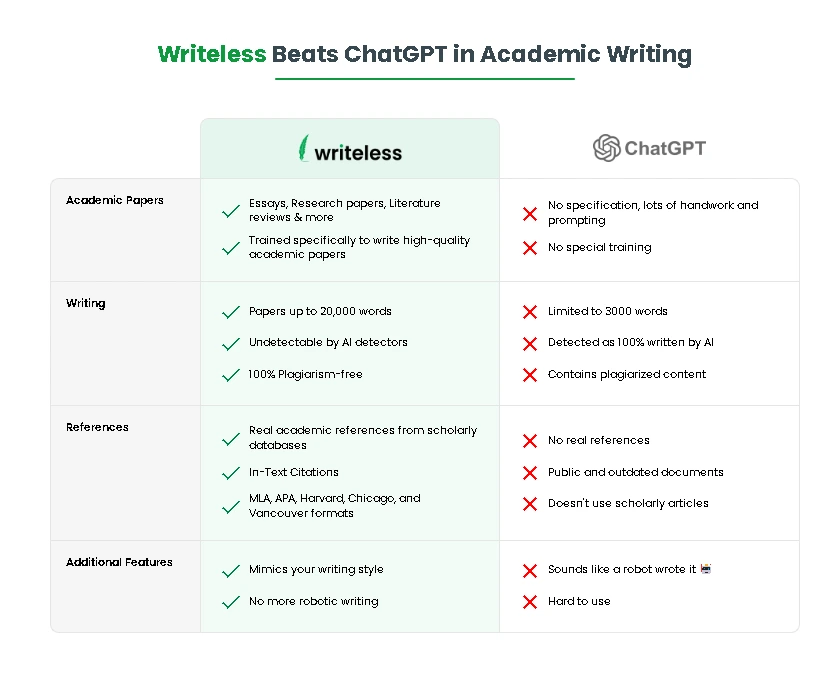
Is Write less AI better than ChatGPT for writing?
For essays and citations, yes. For general reasoning, no — ChatGPT is still more advanced.
Can I use Write less AI for long-form blog posts?
Absolutely. It can generate structured blog posts up to 2,000+ words.
Is Write less AI worth paying for in 2025?
If you’re a student, blogger, or need academic writing support, then yes — it’s worth it.
Conclusion
Writeless AI is more than just a writing tool — it’s a quiet companion for moments when creativity feels distant. It doesn’t replace your voice; it strengthens it. If you’re searching for something simple, reliable, and emotionally aware, Write less AI delivers more than you expect. In a world full of noise, writing should feel peaceful — and this tool brings some of that peace back to the process.