

Every writer has a few words they lean on. AI models have a few hundred, and readers have learned them by heart. One “delve” in the first paragraph and half your audience has already decided who, or what, wrote the piece.
That reaction isn’t just a hunch. Researchers at Florida State University identified 21 words whose use in scientific abstracts spiked sharply over four years, and many of them showed up far more often in ChatGPT’s writing. In a follow-up experiment with hundreds of participants, people reacted much more negatively to “delve” than to the other buzzwords. The team also found a likely cause: the human preference data used to fine-tune models seems to push them toward these exact words.
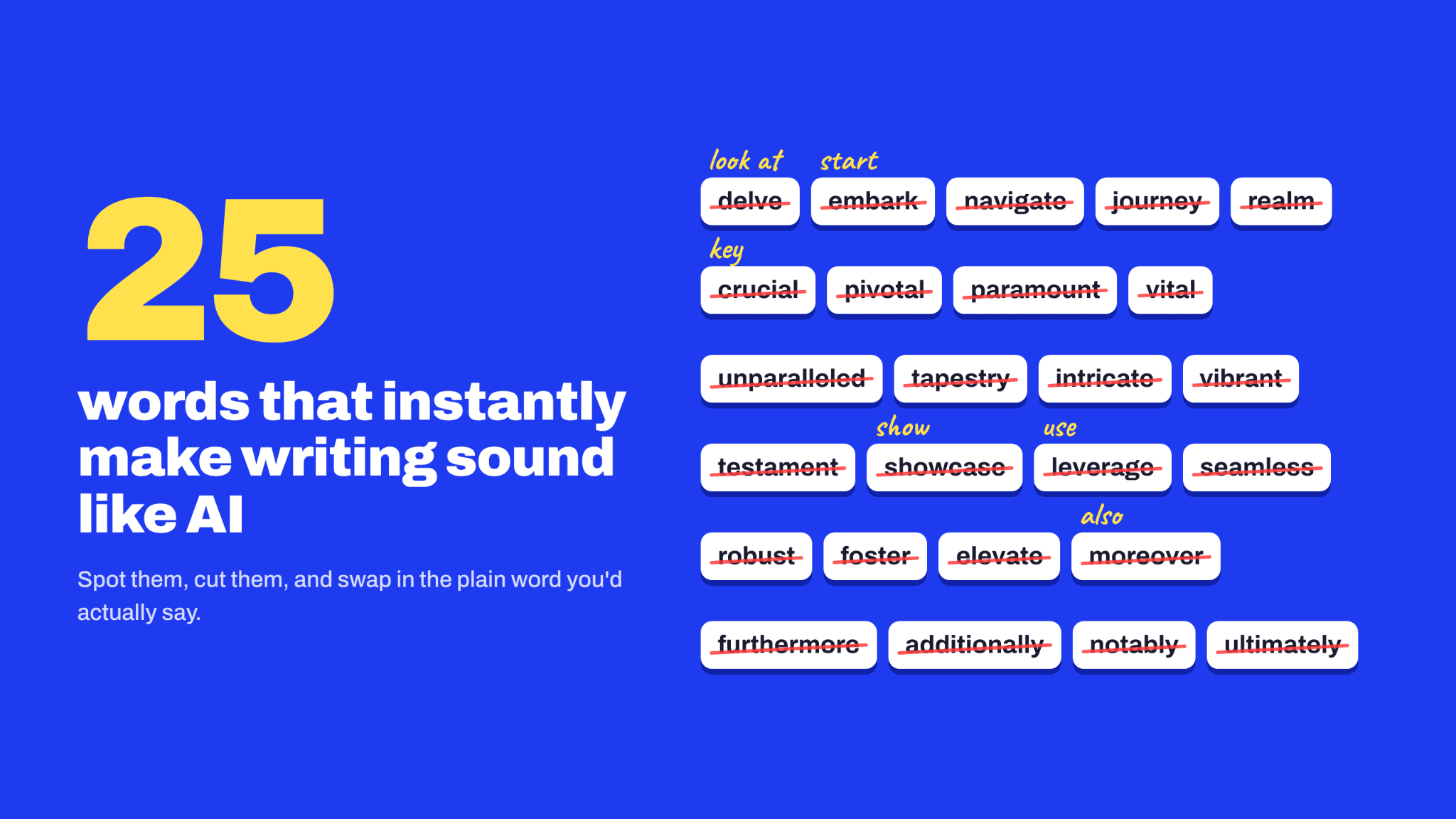
So if you’ve ever pasted a draft into a search bar with the plea “make my text human written”, start here. Below are 25 words that give AI writing away, sorted into five families, with plain swaps for each. Cut them, and your draft will read as yours long before you touch anything else.
Family 1: The Explorers
AI loves to treat every topic like an expedition. Nobody simply discusses something. They delve into it, embark on it, and navigate its realm.
| Word | Why it gives you away | Say this instead |
|---|---|---|
| 1. Delve | The most famous AI tell of all | look at, dig into, cover |
| 2. Embark | Turns every task into a voyage | start, begin |
| 3. Navigate | Used for anything vaguely difficult | handle, deal with, get through |
| 4. Journey | Makes a software update sound like a pilgrimage | process, path, or just cut it |
| 5. Realm | Fantasy-novel word for “area” | field, area, world |
A Stanford study of nearly one million papers flagged “realm” as one of four words, along with “intricate,” “showcasing,” and “pivotal,” whose use grew noticeably after ChatGPT launched. If your draft has two of those four in one paragraph, a careful reader will notice.
Family 2: The Inflators
These words make everything sound more important than it is. When every point is crucial, none of them stands out.
| Word | Why it gives you away | Say this instead |
|---|---|---|
| 6. Crucial | Applied to almost any noun | key, needed, or explain why it matters |
| 7. Pivotal | Turns ordinary moments into turning points | major, deciding |
| 8. Paramount | Sounds like a legal brief | most important, first priority |
| 9. Vital | Overused alongside “crucial” | needed, essential (sparingly) |
| 10. Unparalleled | A claim nobody can check | a specific comparison with a number |
The real fix for inflators is evidence. Instead of “customer feedback is crucial,” write what happened when you ignored it.
Family 3: The Decorators
These words add sparkle where nobody asked for it. They’re the verbal equivalent of stock photos. Decorators are often the first words people cut when they set out to make AI text human written, because once you know them, they’re easy to spot.
| Word | Why it gives you away | Say this instead |
|---|---|---|
| 11. Tapestry | Nobody outside a museum says it | mix, range |
| 12. Intricate | Used for anything with more than two parts | detailed, complex |
| 13. Vibrant | Every city, culture, and community gets it | Describe what you actually saw or heard |
| 14. Testament | “A testament to” opens a cliché | shows, proves |
| 15. Showcase | Everything is showcased; nothing is shown | show, display |
Family 4: The Corporate Crew
These come straight from a slide deck. They aren’t wrong, but stacked together they sound like a press release written by nobody.
| Word | Why it gives you away | Say this instead |
|---|---|---|
| 16. Leverage | A long way of saying “use” | use |
| 17. Seamless | Almost nothing is seamless | smooth, easy, or name the friction removed |
| 18. Robust | Vague praise for systems and plans | reliable, thorough, strong |
| 19. Foster | Common in “foster a sense of community” | build, encourage |
| 20. Elevate | Everything gets elevated, from brands to coffee | improve, raise |
Family 5: The Connectors
AI glues paragraphs together with formal transitions that announce a new point without explaining how it connects. These are some of the easiest tells to spot because they cluster at the start of sentences. Cutting them won’t make my text human written on its own, but it removes the stiffest sentence openers in a single pass.
| Word | Why it gives you away | Say this instead |
|---|---|---|
| 21. Moreover | Rare in natural modern writing | also, and, or nothing |
| 22. Furthermore | Same problem, slightly longer | and, plus |
| 23. Additionally | Signals a list with no logic | also, or restructure |
| 24. Notably | Points at something without saying why it matters | Say why it matters |
| 25. Ultimately | The classic AI conclusion opener | So, in the end, or start with the point |
Why Swapping Words Isn’t Enough
Here’s the catch. You can delete all 25 words and still end up with text that sounds machine-made. AI writing has patterns beyond vocabulary: sentences of the same length, lists that always come in threes, paragraphs that open by restating the heading and close by summarizing it. That’s why so many people who search “make my text human written” end up disappointed with simple synonym tools.
So treat this list as a first pass. If the goal is to make my text human written in a way that holds up, use it like this:
- Search and flag. Use your editor’s find tool for each family. Don’t fix anything yet. Just count. If the hits pile up in one section, that section needs real work.
- Swap or delete. About half the time, the best replacement is nothing. “It’s crucial to note that prices rose” becomes “Prices rose.”
- Replace vague with specific. Every time you remove an inflator or decorator, ask what concrete detail could take its place: a number, a name, an example.
- Read it aloud. Your ear will catch the rhythm problems a word list can’t.
A Word of Caution About Word Lists
None of these words is banned, and none of them proves a machine wrote something. People wrote “delve” and “furthermore” long before ChatGPT existed, and a single “robust” in a technical report is perfectly normal. Judging a writer by one word is unfair, and some readers do it anyway.
What gives AI writing away is density: five or six of these in a short section, usually alongside the even rhythm described above. Detectors work on similar patterns. They score how predictable the text is overall, and this guide on how detectors measure predictable writing explains why swapping vocabulary alone rarely changes a score much.
Your Own Words Win
The irony of AI vocabulary is that it tries so hard to sound impressive. “Delve,” “tapestry,” and “paramount” all reach for polish. What readers want is clarity, and clarity usually comes in shorter, plainer words.
So the next time a voice in your head says “make my text human-written,” don’t reach for a thesaurus. Reach for the word you’d use if you were explaining the idea to a friend across the table. That word is seldom “delve.”