
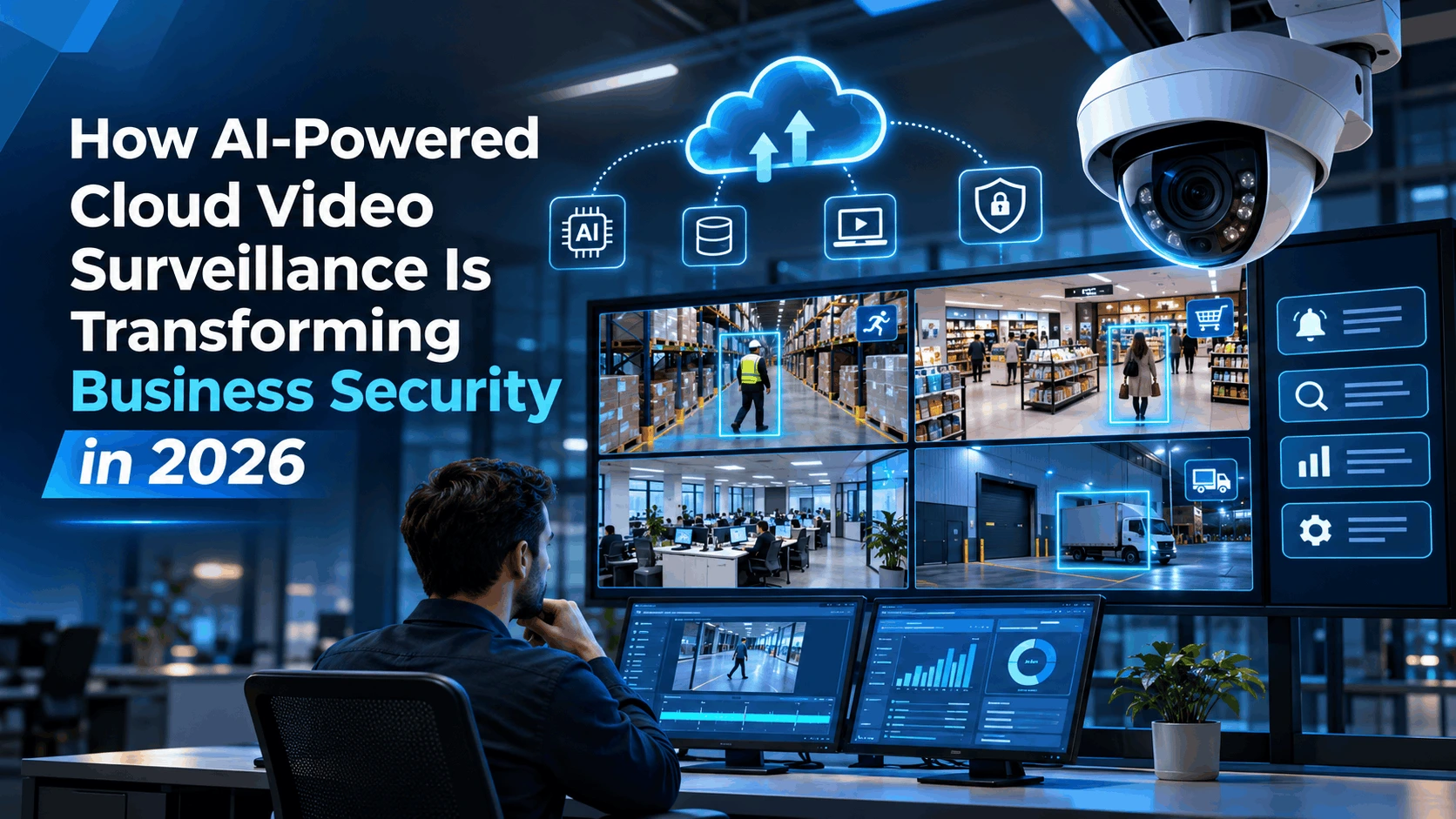

Business security is changing rapidly, and traditional CCTV systems are struggling to keep up. Companies no longer want cameras that simply record incidents. They need systems that can identify suspicious activity, retrieve footage quickly, and help security teams respond before minor problems become expensive.
The numbers explain why. According to Flexera’s 2026 State of the Cloud Report, 73% of surveyed organizations use hybrid cloud environments, reflecting how businesses increasingly combine local infrastructure with cloud technology. Meanwhile, IBM’s 2025 Cost of a Data Breach Report found that the average global data breach cost reached $4.44 million, highlighting the importance of protecting business information, including sensitive surveillance footage.
Consider a retail chain managing 20 stores or a warehouse operating around the clock. Manually reviewing hundreds of hours of footage is inefficient, especially when an incident requires immediate attention.
This is where AI-powered cloud video surveillance is making a difference. By combining intelligent analytics, remote access, and flexible storage, businesses can move from reactive monitoring toward more proactive security.
In this article, we’ll explore how this technology is transforming business security in 2026, its practical benefits, and what organizations should consider before adopting it.

1. Moving Beyond Traditional CCTV With Intelligent Cloud Storage
Traditional surveillance systems typically store footage on local digital video recorders (DVRs), network video recorders (NVRs), or dedicated servers. Although these systems remain useful, managing storage across several business locations can become complicated and expensive.
For example, a company with 10 cameras recording continuously at an average bitrate of 2 Mbps would generate approximately 216 GB of footage daily. Over 30 days, that adds up to roughly 6.5 TB of video data, before accounting for backups or additional storage overhead.
As businesses expand, their storage requirements grow accordingly.
Cloud-based surveillance addresses several of these challenges by allowing authorized teams to access footage remotely and scale storage without constantly expanding on-site hardware.
Its practical advantages include:
- Remote accessibility: Managers can review footage from different business locations without visiting each site.
- Flexible storage: Organizations can adjust capacity and retention periods as their camera networks grow.
- Better resilience: Off-site copies can protect important recordings from local hardware damage or theft.
- Centralized management: Security teams can oversee multiple locations through a common platform.
However, cloud storage still requires reliable connectivity, appropriate cybersecurity controls, and careful cost planning. Many businesses therefore choose hybrid systems that combine local recording with cloud access and storage.
2. Using AI Alerts to Identify Security Threats Earlier
One of the biggest weaknesses of conventional surveillance is its dependence on human attention.
A security employee monitoring 30 camera feeds cannot realistically observe every activity simultaneously. Important incidents may go unnoticed until someone reports a problem or reviews recorded footage.
AI-powered surveillance helps address this limitation by analyzing video and identifying events that may require attention.
Depending on the system, intelligent monitoring can recognize unusual movement, unauthorized entry, people entering restricted zones, or activity occurring outside normal business hours.
Consider a warehouse that closes at 10 p.m. If someone enters a restricted loading area at midnight, an AI-enabled system may generate an alert for authorized personnel to review.
This changes how security teams operate in three important ways:
- Faster awareness: Relevant activity can be flagged while it is happening.
- More focused monitoring: Employees spend less time watching uneventful footage.
- Better incident assessment: Security teams can review visual context before deciding how to respond.
AI alerts are not perfect. Poor lighting, environmental conditions, and incorrectly configured detection rules can generate false alarms. Businesses should test detection accuracy and maintain human oversight for important security decisions.
3. Making Video Search Faster With AI-Powered Analytics
Finding a particular incident in traditional CCTV footage can be surprisingly difficult.
Imagine a retail manager investigating a missing inventory item. The manager knows it disappeared sometime between 2 p.m. and 6 p.m., but reviewing four hours of footage across several cameras could take considerable time.
AI-powered video search changes that process by allowing users to locate footage based on identifiable objects, people, or events rather than relying exclusively on timestamps.
This capability is particularly valuable when combined with cloud storage video surveillance, which makes recordings accessible across different locations.
For example, Coram offers a hybrid-cloud surveillance platform that combines video storage with AI-powered search. According to its published product information, users can search recordings for specific events, objects, or people, including individuals wearing particular clothing. The platform also supports automated storage management, integration with IP cameras, and customizable retention periods ranging from 30 to 365 days.
For businesses managing large volumes of footage, this demonstrates how intelligent search and flexible storage can work together to simplify investigations.
Instead of treating video as an archive that employees must manually examine, organizations can use searchable footage as a practical operational resource.
4. Simplifying Security Management Across Multiple Business Locations
Managing security becomes more challenging as businesses expand beyond a single office, store, or facility.
A company operating 15 retail locations might have different camera configurations, storage devices, and security procedures at each site. Without centralized management, investigating incidents or maintaining consistent policies can require significant coordination.
Cloud-based surveillance helps organizations bring these operations together.
Authorized security personnel can review footage from multiple locations, monitor camera availability, and manage access permissions through centralized software.
This approach also aligns with broader enterprise technology trends. Flexera’s 2026 research found that 73% of organizations surveyed operate hybrid cloud environments, showing how established businesses increasingly rely on combinations of cloud and local infrastructure.
For surveillance, centralized management offers several practical benefits:
- Consistent monitoring policies across branches
- Easier access to recordings during investigations
- Reduced dependence on separate local monitoring stations
- More efficient onboarding of new business locations
A restaurant franchise, for example, could use centralized monitoring to investigate repeated after-hours entry incidents across several branches without sending a manager to retrieve recordings from each location.
The result is a security operation that can expand alongside the business rather than becoming more difficult to manage with every new site.
5. Strengthening Data Protection and Surveillance Compliance
Moving security footage into the cloud creates opportunities for better management, but it also introduces cybersecurity responsibilities.
Video recordings may contain identifiable employees, customers, visitors, confidential workplace activities, or sensitive operational information. Unauthorized access to this footage can create privacy and reputational risks.
IBM’s 2025 research reported an average U.S. data breach cost of $10.22 million, compared with the global average of $4.44 million. These figures cover data breaches broadly, not surveillance-specific incidents, but they demonstrate why organizations must treat cloud-hosted information as a valuable security asset.
Businesses adopting cloud surveillance should prioritize:
- Encryption: Protect footage during transmission and storage.
- Multi-factor authentication: Reduce the risk of unauthorized account access.
- Role-based permissions: Restrict recordings to employees with legitimate responsibilities.
- Retention policies: Keep footage only as long as operational and legal requirements justify.
- Audit trails: Maintain records of who accessed or exported sensitive recordings.
Organizations should also evaluate applicable privacy laws and employee-monitoring requirements before deploying AI analytics.
Cloud surveillance should improve physical security without creating unnecessary exposure of personal information.
6. Reducing Operational Costs While Improving Security Efficiency
One reason businesses are reconsidering traditional surveillance is the ongoing cost of maintaining physical infrastructure.
Local storage systems may require hard-drive replacements, server maintenance, software updates, additional equipment, and occasional on-site troubleshooting.
Cloud surveillance can reduce some of these responsibilities, although subscription fees, bandwidth requirements, and long-term storage expenses must also be considered.
For example, a growing retail company may find that expanding local storage at every new location requires repeated hardware purchases. A cloud or hybrid approach could simplify capacity planning and reduce the need for separate storage infrastructure at each site.
AI analytics may also improve operational efficiency by reducing time spent manually searching recordings.
Before selecting a system, businesses should compare:
| Consideration | Traditional Local Surveillance | Cloud or Hybrid Surveillance |
| Storage expansion | Often requires hardware upgrades | Can offer flexible capacity |
| Remote access | Depends on system configuration | Commonly built into the platform |
| Video retrieval | Often relies on manual review | May include AI-assisted search |
| Maintenance | Greater responsibility for local hardware | Some infrastructure managed by provider |
| Ongoing expenses | Hardware, support, replacements | Subscriptions, storage, bandwidth |
Neither approach is automatically cheaper. The right choice depends on camera count, recording quality, retention requirements, connectivity, and the organization’s existing infrastructure.
Businesses should evaluate total ownership costs over several years rather than comparing initial purchase prices alone.
7. Preparing for the Next Generation of Enterprise Security
In 2026, business surveillance is increasingly becoming part of a broader technology strategy rather than an isolated camera installation.
AI analytics, cloud storage, remote monitoring, and centralized management are creating opportunities for more coordinated security operations.
A logistics company, for instance, might combine video monitoring with access control records to investigate unauthorized entry. A retailer might use searchable recordings to understand repeated incidents around inventory storage areas.
However, successful adoption requires clear objectives.
Organizations should begin by identifying their highest-risk areas, assessing existing cameras, testing network reliability, and determining which AI capabilities would genuinely improve their security workflows.
Starting with a limited pilot can help teams evaluate alert accuracy, video quality, storage costs, and employee usability before expanding across an entire organization.
The businesses that benefit most will be those that use AI to support informed human decisions rather than expecting technology to eliminate every security risk.
Key Takeaways
- AI-powered cloud surveillance is changing business security by combining intelligent video analytics with remote access and scalable storage.
- Real-time alerts improve situational awareness by helping security personnel identify activity that may require attention.
- AI video search simplifies investigations by making it easier to locate relevant recordings without manually reviewing hours of footage.
- Hybrid-cloud adoption is growing, with 73% of surveyed organizations using hybrid cloud environments in Flexera’s 2026 report.
- Cybersecurity remains essential, particularly when surveillance footage contains sensitive personal or business information.
- Businesses should evaluate long-term costs, including subscriptions, bandwidth, storage retention, and integration with existing equipment.
FAQs
What is AI-powered cloud video surveillance?
It combines security cameras, cloud-based video management, and artificial intelligence to help businesses store recordings, search footage, monitor locations remotely, and identify events that may require attention.
How does AI improve traditional CCTV systems?
AI can analyze video for specific activities, generate alerts, and make recordings easier to search. This reduces dependence on continuous manual observation and can help security teams investigate incidents more efficiently.
Is cloud video surveillance suitable for small businesses?
Yes. Small businesses can benefit from remote access, flexible storage, and simplified management. However, they should compare subscription costs, internet requirements, and available features before choosing a platform.
Is cloud surveillance more secure than local storage?
Neither approach is inherently more secure. Cloud systems can offer encryption, access controls, and off-site storage, while local systems provide greater direct control over infrastructure. Security depends on configuration, maintenance, and operational practices.
Can businesses use existing cameras with cloud surveillance?
Many platforms support compatible IP cameras, allowing businesses to modernize video management without replacing their entire camera network. Compatibility should always be confirmed before purchasing.
Conclusion
AI-powered cloud video surveillance is changing how businesses approach security in 2026. Instead of relying entirely on cameras that record incidents for later investigation, organizations can use intelligent alerts, searchable footage, and centralized management to improve awareness and operational efficiency.
The real value lies in combining these capabilities with secure storage, clear policies, and responsible human oversight.
As AI becomes more deeply integrated into business operations, the question is no longer simply how much footage a company can record, but how effectively it can turn that footage into meaningful security decisions.